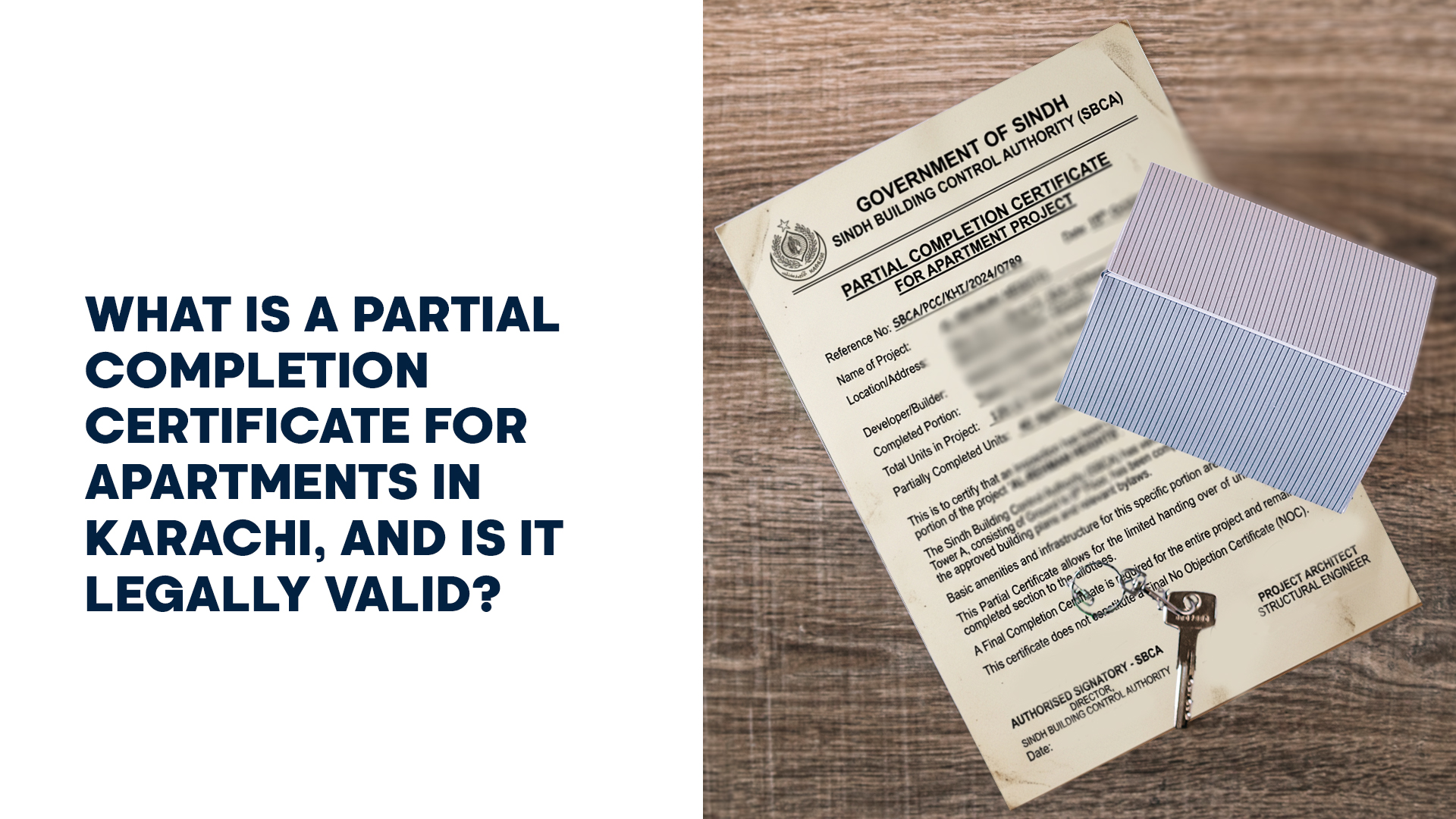
What Is a Partial Completion Certificate for Apartments in Karachi, And Is It Legally Valid?
Karachi's apartment market has grown rapidly over the past decade. Thousands of buyers are receiving keys to their units before developers have obtained a full Completion Certificate from the Sindh Building Control Authority (SBCA). In many cases, a Partial Completion Certificate in Pakistan is handed over as a substitute. Most buyers accept it without fully understanding what it covers, what it does not, and the risks it leaves open. This blog explains all of that in plain terms, so you can make a decision that protects your investment.
What Is a Completion Certificate in Karachi?
A Completion Certificate (CC) is an official document issued by SBCA after a final site inspection. It certifies that the completed construction matches the approved building plan in all respects. More practically, it is the document a developer must obtain before applying for permanent utility connections, electricity, gas, and water, on behalf of the building and its residents.
The legal basis for this lies in Regulation 3-2.15 of the Karachi Building & Town Planning Regulations 2002. Under this regulation, any person who undertakes and completes building works, in whole or in part, must submit a Notice of Completion to SBCA within one month. This notice must be accompanied by a Completion Plan showing the building exactly as it was constructed, not as originally approved on paper.
SBCA is the regulatory and supervisory body responsible for ensuring that building plans and NOCs conform to the Karachi Building and Town Planning Regulations. It is also responsible for protecting public buyers by confirming that buildings are constructed according to design specifications, delivered on time, and equipped with utilities as per the developer's agreement with purchasers.
The process for obtaining a Completion Certificate involves six key stages: land title verification, issuance of the construction permit, site inspection during construction, post-construction inspection, final inspection, and issuance of the CC. Only once SBCA has completed all six stages does the building attain a clean legal status.
What Is a Partial Completion Certificate (PCC)?
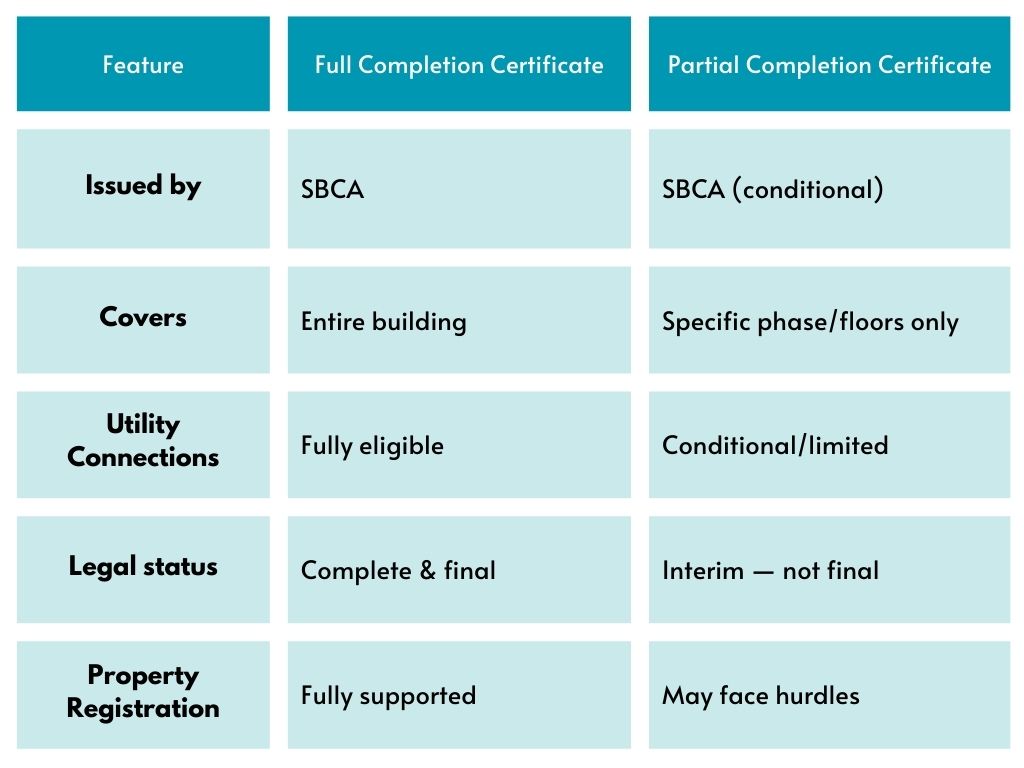
A Partial Completion Certificate is issued by SBCA when one portion or phase of a building is complete, while the rest of the project is still under construction or awaiting utility connections. It is essentially an interim acknowledgment, not a final approval.
The Karachi Building & Town Planning Regulations 2002 include a specific provision that serves as the basis for PCCs. The regulation states that, when building work is complete in all respects. Still, utility services have not yet been connected, and the developer has paid the relevant utility estimates; the SBCA may still consider a completion or occupancy certificate. This provision allows PCCs to exist in principle, though they are not formally defined as standalone documents, unlike the full CC.
In practice, local authorities in Karachi and across Pakistan sometimes grant partial occupancy certificates for completed towers or phases when common safety infrastructure, such as fire exits, pumps, and alarms, is already in place. This allows residents to move into finished blocks while the remaining phases are completed. However, the full Completion Certificate remains the ultimate legal requirement for the entire project.
This distinction is important: a PCC can be legitimate and useful in a phased development, but only when it explicitly covers your specific unit or floor, and only when the developer has a clear, time-bound commitment to obtain the full CC.
Full Completion Certificate vs. Partial Completion Certificate
Is a Partial Completion Certificate Valid in Karachi Legally?
This is the most important question any apartment buyer should ask, and the answer is nuanced. A PCC has conditional legal standing. It is not equivalent to a full Completion Certificate, and it leaves buyers exposed to real legal and practical risks. Buyers, however, can take legal possession with a partial CC, but legal ownership remains incomplete until SBCA issues a full Completion Certificate.
In April 2025, Sindh Local Government Minister Saeed Ghani directed the SBCA to formally contact KElectric, Karachi Water & Sewerage Corporation (KW&SB), and Sui Southern Gas Company (SSGC) to prevent them from providing utility services to any building without an SBCA Completion Certificate. This directive originated at the highest level of provincial governance and directly affects residents in buildings that have not yet obtained full CCs.
The same directive instructed that sub-registrars of land under the Sindh Board of Revenue must not issue leases to buildings without Completion Certificates. This matters greatly to buyers because it means that an apartment in a building without a full CC may not be formally registered in the buyer's name, leaving legal ownership in a grey area.
Courts in Sindh have also issued orders in line with this position. The Sindh High Court has previously directed SBCA to provide detailed accounts of buildings constructed without approved plans in District Central, signaling judicial awareness and intent to enforce compliance. A Sindh court also ordered that no utility connections be provided to any building without an approved building plan, and KW&SB confirmed that no water connections would be provided to illegally constructed buildings.
What this creates, in practical terms, is a regulatory environment where a PCC may allow you to occupy a unit but may not protect you from being denied utilities, property registration, or legal title, all of which are fundamental to owning an apartment in Karachi.
SBCA can take action on buildings with only a Partial Completion Certificate if the overall project remains non-compliant, including issuing FIRs, blocking utility connections, and ordering demolition of unauthorized portions.
How Partial Completion Certificates Work in Apartment Projects
Partial CCs are relatively common in large apartment developments, especially in projects built in phases or with multiple towers, because completing and certifying the entire structure at once can take several years.
Although they are more frequently associated with high-rise buildings due to their scale and phased construction, partial CCs are not limited to high-rises; mid-rise or multi-block residential projects may also receive them if different sections are completed at different times.
Importantly, a partial CC is not the final stage. Once the entire project is completed in accordance with approved plans and all regulatory requirements are satisfied, the developer can apply to the Sindh Building Control Authority for a full Completion Certificate, thereby upgrading the building's status from partial compliance to full completion.
What Risks Does a Buyer Face With Only a PCC?
Buying an apartment with only a partial completion certificate exposes you to five distinct risks. Each one can have long-term financial and legal consequences.
Utility Connections May Be Denied
KElectric has assured courts that no connection will be given to any client without a valid, approved building plan. As of 2025, SSGC has imposed a moratorium on new domestic gas connections, with RLNG connections limited to private housing societies. Buyers in buildings without full Completion Certificates may face indefinite delays in obtaining legal utility hookups or be forced to rely on informal, unregulated alternatives.
Property Cannot Be Formally Registered
Purchasing without relevant authority approvals can make a transaction legally vulnerable. If a property cannot be registered at the sub-registrar's office because the building lacks a CC, the buyer's name does not appear on a formal title deed. This significantly weakens ownership rights, particularly in disputes, inheritance, or resale.
Demolition Exposure
SBCA officials have been directed to lodge FIRs against individuals involved in illegal constructions. Demolition committees across Karachi's districts have been revived to act on non-compliant buildings. If a building is found to violate its approved plan, something a PCC does not rule out, demolition orders can be issued, with residents having limited legal recourse.
Investment Value Is Compromised
Without a full Completion Certificate, resale becomes difficult, mortgage financing is nearly impossible, and bank loans secured against the property cannot be obtained. Buyers entering the market with a PCC-only apartment are effectively holding an asset with a ceiling on its market value until the developer delivers the full CC.
Builder Defaults Leave Buyers Stranded
If a developer stops construction before obtaining the full CC, due to financial trouble, disputes, or abandonment, the buyer holding only a PCC has limited recourse. The apartment remains technically unregistrable, and pursuing legal action through Pakistani courts is both slow and expensive. This is the worst-case scenario, and it happens more often than the market acknowledges.
When Is a Partial Completion Certificate Acceptable?
Not all Partial Completion Certificates carry equal risk. In a phased development where each tower or block is constructed and certified independently, a PCC can be a reasonable interim document, provided certain conditions are met.
A PCC may be acceptable when the certificate explicitly covers the specific tower or floor you are purchasing, and when common safety systems, including fire pumps, exits, staircases, and alarm systems, are already functional in your block. It must be treated as a temporary document, not a final one. The developer must also have a written, time-bound commitment with SBCA to deliver the full CC for the entire project.
Beyond this, the PCC must cover your unit specifically, not just the project in general. A blanket PCC issued for Phase 1 of a 10-phase development tells you very little about the legal status of your individual flat. It must include your floor and unit numbers. Additionally, your sale agreement must include a penalty clause specifying financial penalties for the developer if the full CC is not obtained within a defined period.
Verify the building's SBCA status independently. SBCA maintains records that can be checked through their official channels. Do not rely solely on what the developer tells you. Independent verification provides a factual baseline before you sign anything.
Builders can sell apartments using partial CC, but they must obtain a No Objection Certificate (NOC) from the SBCA for public sale before selling any units. A Partial Completion Certificate alone does not authorize a developer to advertise or sell apartments to the public.
How to Verify If a Partial Completion Certificate Is Authentic in Karachi
Verifying a Partial Completion Certificate is straightforward, but it does require going beyond what the developer provides. A document can appear official yet be fabricated, outdated, or issued for a different phase than the one you are entering. Here is how to check it properly.
1. Visit the SBCA Office Directly
The most reliable method is to visit the SBCA office relevant to your building's district. Karachi is divided into five districts, each with its own SBCA office. Bring the building's address, the developer's name, and the CC or PCC document number. SBCA staff can cross-check the certificate against their official records and confirm whether it was genuinely issued.
2. Check the SBCA Single Window Portal
SBCA has been progressively digitizing its approval and certification records through its Single Window Facility. You can check whether a building's plan, NOC, and completion status are registered in the system. If the building does not appear in the portal at all, that is an immediate red flag.
3. Verify the Document Number and Date
Every SBCA-issued certificate carries an official document number, the date of issuance, the name of the authorized signatory, and the SBCA stamp. Cross-check the document number with SBCA directly. Also, confirm that the issuing officer's designation matches the authority level required to issue a PCC; not every SBCA official has this authority.
4. Confirm Which Floors and Units It Covers
A legitimate PCC will explicitly state which phase, floors, or units it applies to. If the certificate is vague, covering the "project" in general without naming specific blocks or floor numbers, ask SBCA to clarify in writing what the certificate actually covers. Your unit must fall within the stated scope.
5. Ask for the Approved Building Plan Reference
A valid PCC is always linked to an SBCA-approved building plan. Ask the developer for the approved plan number and verify with SBCA that the PCC was issued against that exact plan. If the building was constructed in a manner different from the approved plan, the PCC may have been issued conditionally or may not be valid.
6. Engage an Independent Property Lawyer
Before signing any sale agreement, have an independent property lawyer, not the developer's in-house counsel, review the PCC alongside the building's full documentation trail. A lawyer can file a formal inquiry with SBCA on your behalf and flag any discrepancies that an ordinary buyer might miss.
What Buyers Should Demand Before Signing: A Document Checklist
Before signing any apartment sale agreement in Karachi, request and independently verify each of the following ownership documents. A fully compliant developer has no reason to withhold any of them.
- SBCA-approved building plan, confirm that it matches what was actually built on site, not just what was submitted.
- NOC for public sale from SBCA; this is legally required before a developer can advertise or sell any units to the public.
- Full Completion Certificate, or a written SBCA-issued interim certificate that explicitly names the floors and units it covers.
- Confirmation that the building is listed on the SBCA portal as compliant and plan-approved.
- Sale agreement containing a CC delivery clause with a specific deadline and a financial penalty for non-delivery.
- Verified utility connection status with KElectric, KW&SB, and SSGC, and confirmed that applications have been filed and are active.
- Sub-registrar eligibility check, confirm that the unit can be registered in your name on the day of possession.
This checklist is not excessive due diligence. It is the minimum standard that protects your legal rights as a buyer in Karachi's property market.
Protecting Your Payments in Projects With Partial CC
A property registry alone does not fully protect buyers if a project has only a partial Completion Certificate, because the registry primarily records the transfer of ownership, while building compliance and completion are regulated by the Sindh Building Control Authority.
If only a partial CC exists, it generally indicates that only a portion of the building has been officially approved for completion, while the remainder may still be under construction or awaiting regulatory clearance.
To protect token money or installment payments in such cases, buyers should verify the project’s approved building plans, confirm the validity of the partial CC with the Sindh Building Control Authority, ensure the sale agreement clearly mentions the specific approved portion of the building, and preferably make payments through documented banking channels so that financial records and contractual safeguards exist if disputes arise.
What You Should Take Away
A Partial Completion Certificate for apartments in Karachi is a conditional, interim document. It is not a substitute for a full SBCA Completion Certificate, and treating it as one can expose buyers to utility denials, registration hurdles, demolition risk, and compromised resale value.
The regulatory environment in Karachi is changing. SBCA, Sindh courts, and utility providers are all moving toward stricter enforcement. Buyers who enter transactions without understanding this landscape are taking on risks that could have been avoided with basic due diligence. Ask the right questions before you sign. Demand the right documents. And work only with developers who can provide them without hesitation.
FAQs
1. Can banks accept partial CC for financing?
Some banks may consider financing units covered under a partial Completion Certificate, but approval usually depends on the bank’s internal risk assessment and verification of the project’s approval status with the Sindh Building Control Authority.
2. How to check which floors/blocks are included in a partial CC?
You can verify which floors or blocks are covered by reviewing the official partial Completion Certificate document issued by the Sindh Building Control Authority, which specifies the approved sections of the building.
3. When should buyers demand a full Completion Certificate?
Buyers should ideally require a full Completion Certificate from the Sindh Building Control Authority before final possession or full payment for the property.