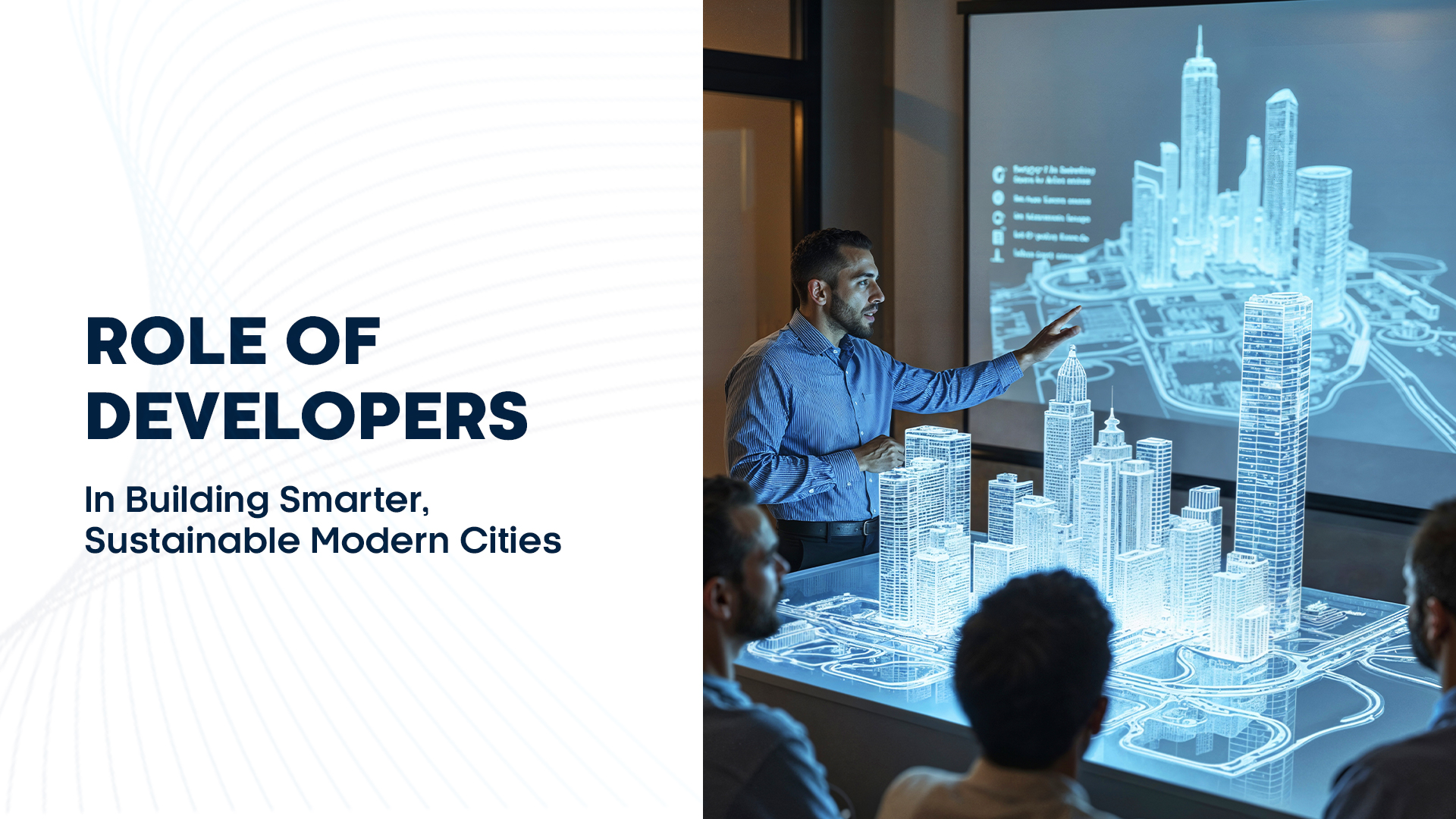
Role of Real Estate Developers in Building Smarter, Sustainable Modern Cities
The Role of real estate developers in today’s cities goes far beyond erecting buildings. As urban populations surge and lifestyles evolve, developers are now pivotal in shaping the future of urban living through innovative, sustainable, and technology-driven solutions. With nearly 70% of the world’s population expected to live in cities by 2050, the demand for smarter and greener cities has become a global imperative, not just an ideal.
Real estate developers bear a dual obligation to produce safe, usable living areas as well as to help to achieve citywide sustainability by combining digital infrastructure, eco-friendly materials, and community-centric planning. By doing so, they support a vision increasingly important for contemporary city life: balancing economic expansion with environmental protection and better quality of life.
What It Means to Build Smarter, Sustainable Cities
Constructing intelligent, sustainable cities means designing technologically sophisticated and ecologically friendly urban areas. Unlike conventional cities, smart sustainable ones use inventions including data analytics, artificial intelligence (AI), and Internet of Things (IoT) to enhance urban systems, including public services, resource allocation, and utility, as well as transit.
Real estate developers at the forefront of this transformation must focus on several key principles:
- Reduced carbon footprint through energy-efficient design and materials.
- Efficient infrastructure that leverages smart technologies for utilities and services.
- Inclusive planning to ensure accessibility and community well-being.
- Enhanced quality of life through green spaces, mobility, and intelligent urban services.
How Developers Shape Cities: Key Roles
Modern developers have a big role in integrating smart infrastructure and digital technologies into urban planning, modifying structures to engage with and maximize the urban environment in addition to accommodating people.
Transforming Land into Lived-in Communities
One of the most basic duties real estate developers have is transforming unused urban areas or undeveloped ground into habitable, practical settlements. Beyond just erecting structures, this process entails deliberate master planning that combines residential units, retail stores, offices, green areas, and recreational facilities into a coherent environment.
Developing mixed-use neighborhoods helps developers create self-sustaining urban ecosystems, promote social contact, and lower the requirement for lengthy commutes. These changes promote belonging while boosting everyday convenience for inhabitants and supporting economic activity.
Creating “15-Minute” Cities
Rising forward-thinking designers are adopting the “15-minute city” idea, which provides quick walking or bike access to vital services, including schools, medical care, grocery stores, employment, and leisure amenities. This method gives human-scale planning first importance, therefore supporting walkability and active transit while lowering car dependence.
Design of small, walkable communities lets property developers reduce carbon emissions, relieve traffic bottlenecks, and foster more active lifestyles. The outcome is a more inclusive and effective metropolitan setting that improves quality of life while promoting sustainable city development.
Infrastructure and Urban Expansion
By creating the basic infrastructure that allows for increasing populations, the role of property developers in urbanization is important. Often, residential developments are built in conjunction with roads, drainage systems, water supply networks, electricity, and telecommunications infrastructure.
This coordinated growth guarantees that freshly developed urban areas start to work day one. By funding infrastructure, property developers not only help to create housing demand but also help to build city resilience, improve service delivery, and support long-term urban planning goals.
Urban Regeneration
Another major field in which urban developers help shape modern cities is urban regeneration. By renewing neglected or dying areas, builders turn vintage structures and surroundings into current, usable areas. This usually entails retrofitting infrastructure, adaptive reuse of current buildings, and the addition of fresh residential or commercial activity.
Such regeneration improves safety and livability, draws investment, and raises property values. More significantly, it guarantees that cities grow without pointless sprawl by maintaining urban character while infusing fresh energy into local areas.
Integrating Smart Technology in Construction & Community Design
Today, urban developers create smart utilities, including energy management systems, sensors, IoT gadgets, and smart grids that enable buildings and communities to be environmentally responsive. For example, smart buildings use data from sensors and automation to change lighting, heating, cooling systems, and power consumption, therefore maximizing total efficiency and lowering trash.
From smart traffic lights that cut travel times to systems that better manage public transportation, embedded technology is also transforming transportation infrastructure, hence lowering emissions and increasing mobility in cities.
Building Future-Ready Digital Infrastructure
Leading in establishing high-speed broadband systems and IoT infrastructure, empowering digital services, real-time utility monitoring, smart waste and water management systems, all fundamental to modern city development, are the developers. These systems assist businesses and services dependent on connection and responsiveness while also raising the quality of life.
Partnering with Government & Telecoms
Smart city planning and developers need cooperation between the public sector and private industry. Developers frequently collaborate with governments and telecom companies to guarantee flawless integration of digital infrastructure like fiber networks, sensor grids, and public data platforms with local planning and laws. This collaboration speeds the adoption of smart solutions that will improve the whole community.
Trends and Innovations Driven by Developers
Sustainability and Green Building
With builders more and more embracing ecologically friendly construction techniques, sustainable urban development has become a main emphasis in current property development. This encompasses going after green building credentials like LEED, which establishes standards for material sustainability, indoor environmental quality, water conservation, and energy efficiency.
While green rooftops help to lower urban heat, boost insulation, and regulate stormwater, features like solar-ready construction let buildings incorporate renewable energy systems with little later alteration. Using energy-efficient materials and systems lowers long-term operational costs in addition to lessening environmental impact, hence making sustainable projects both ecologically friendly and financially feasible.
Smart Home Technology
Integrating smart home and building technology that improves comfort, security, and efficiency, developers are changing house life. Using Internet of Things (IoT) sensors, real-time control of lighting, temperature, energy consumption, and security systems is possible for residents.
Automated lighting and temperature control systems help to reduce energy use; smart locks, cameras, and access control provide more peace of mind. More widely, digital facility management systems let developers and property managers monitor building performance, foresee maintenance requirements, and provide more reactive services, that is, smarter, safer, and more pleasant living environments.
Mixed-Use Development
The growth of mixed-use developments shows a move toward the live-work-play urban paradigm. Developers are increasingly combining leisure amenities, office spaces, retail establishments, and residential units inside a single, interconnected development. Mixed-use development benefits include promoting walkability, lessening traffic congestion, and cutting travel time by positioning everyday needs nearby.
Mixed-use settings also promote social interaction and local enterprises by producing lively, active communities all day and evening. These developments present comfort, lifestyle value, and higher long-term demand for investors as well as inhabitants.
Wellness-Oriented Design
Modern designers are creating environments that promote mental as well as physical wellness, therefore emphasizing health and well-being. Beyond basic amenities, projects today feature meditation rooms, yoga studios, fitness centers, and designs emphasizing natural light as well as specialized green areas.
Access to calm areas and green plants encourages better lifestyles, lowers stress, and raises air quality. Prioritizing wellness-focused design lets builders meet rising consumer knowledge of mental health, work-life balance, and whole living, hence increasing the attractiveness and future-ready nature of their projects.
Sustainability in Construction & Design
Sustainability in construction and design is now a fundamental responsibility for developers, not an option, as contemporary urban development increasingly aligns with Sustainable Development and Smart Cities principles. By adopting Green Buildings practices, developers use eco-friendly materials such as recycled steel, bioconcrete, and sustainable wood alternatives to reduce carbon emissions and support circular economies.
Global standards like the International Green Construction Code (IGCC) guide energy efficiency, air quality, and water conservation. Alongside this, green infrastructure, renewable energy integration, and efficient Public Transport systems enhance environmental resilience. Models like Masdar City demonstrate how smart, sustainable planning delivers measurable long-term environmental benefits.
Enhancing Quality of Life & Community Value
Smarter, sustainable cities are distinguished by their ability to enhance daily life; developers have a crucial part in helping to realize this promise.
Socially Inclusive Urban Development
Urban design that stresses walkable streets, accessible public areas, cultural centers, and mixed-use environments improves social cohesiveness and builds lively neighborhoods where people feel linked and safe.
Accessibility & Urban Mobility
Prioritizing integrated public transit, bicycle lanes, and pedestrian-friendly streets lessens reliance on vehicles, lowers emissions, and improves resident mobility, all vital to a liveable urban environment.
Community Engagement in Planning
Participatory planning methods in smart development let locals help to decide on neighborhood assets, services, and homes. This cooperative strategy guarantees that urban development is both inclusive and responsive to community needs.
Economic and Social Impact of Developers on City Living
Economic Stimulus
A strong economic engine that greatly supports both regional and national economies is real estate development. Through construction activity, it directly contributes to GDP growth while producing significant employment over a range of sectors, including architects, engineers, city planners, contractors, and skilled labor.
Development beyond direct employment boosts demand in related industries, including building services, steel, cement, glass, logistics, and builds a multiplier effect across the economy. Projects foster investment, boost tax income, and help to ensure long-run economic stability as they move from planning to completion.
Public-Private Partnerships (PPPs)
To deliver large-scale urban projects that may be difficult for public authorities to finance independently, real estate developers often collaborate with governments through public-private partnerships (PPPs).
Within this framework, government regulations, municipal authorities, and urban planning authorities play a critical role by setting zoning laws, development guidelines, environmental standards, and approval processes that ensure projects align with broader city master plans.
While public institutions provide regulatory oversight, land access, and policy incentives, private developers contribute capital, technical expertise, and execution efficiency. Commonly applied to transport infrastructure, public spaces, urban regeneration, and affordable housing, public-private partnerships enable cities to upgrade essential amenities more efficiently and sustainably while sharing risk and responsibility between the public and private sectors.
Fostering Social Interaction
Projects intended to promote social interaction and community building are being created more and more by contemporary developers. Property developers design areas where people may interact outside their houses by including common amenities such as parks, plazas, walking paths, play areas, and neighborhood centers. These shared spaces encourage a feeling of belonging, safety, and group identity in gated or self-sustained communities. Such surroundings help create more resilient and close urban communities, enhance mental well-being, and strengthen social bonds.
Addressing Housing Demand
Property developers become very important in solving housing shortages in densely populated cities struggling with a fast population increase and land availability. Karachi and other cities show how moving toward vertical, high-rise construction lets limited land be used effectively while meeting a rising urban population. Rising instead of outward development helps developers curb metropolitan sprawl, boost infrastructure efficiency, and increase home affordability. Meeting urgent housing needs while preserving livability in densely populated metropolitan regions depends on this approach.
Ending Note
Real estate developers' role in building smarter, sustainable modern cities is both visionary and practical. Today's creators are innovators molding the city scene with technology, environmental techniques, and a community-first philosophy rather than just contractors.
This view strikes us profoundly here at Family Builders and Developers. Every project we make shows our dedication to eco-responsibility, inclusion, and forward-looking design, therefore generating not just houses but also energetic, resilient communities that hold the test of time.
Explore our most recent projects if you're prepared to live in a city combining modern comfort with wise, environmentally friendly solutions and help shape more livable cities for tomorrow.