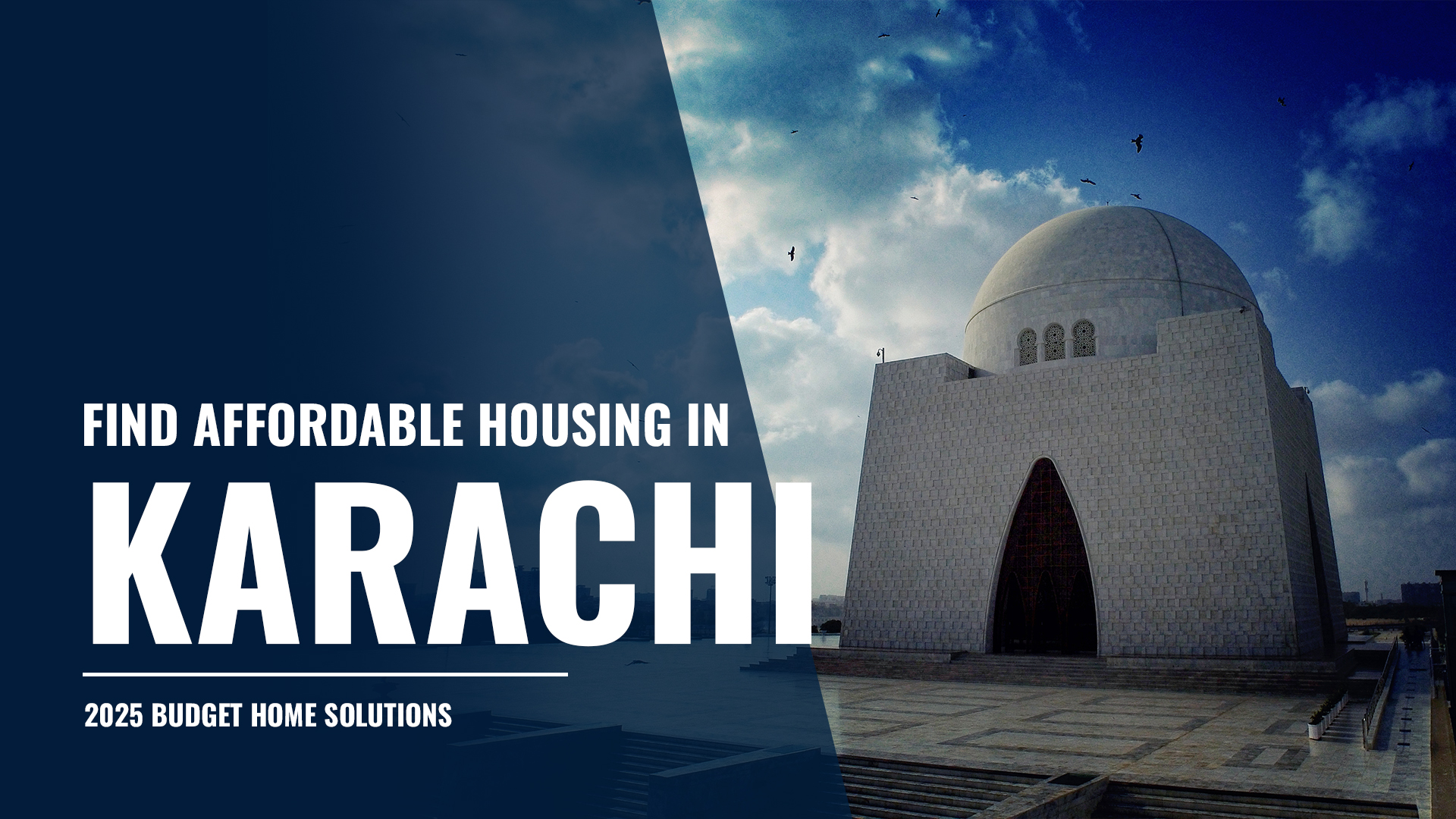
Finding Affordable Housing in Karachi: 2026 Budget Home Solutions
Karachi’s housing market in 2026 faces rising demand, inflation, and limited affordability for middle- and lower-income families. Government policies and SBP-led financing aim to revive homeownership with subsidies and tax relief, though mortgage uptake remains low. Budget-friendly areas like Scheme 33, Malir, and Rashid Minhas Road offer value and accessibility. End-buyers are advised to budget wisely, research thoroughly, and work with trusted developers. Family Builders & Developers stand ready to lead Karachi’s shift toward sustainable, inclusive, and affordable housing solutions.
In 2026, Karachi, Pakistan's economic center, will face an escalating housing affordability crisis. Rapid urbanization, population growth, and rampant inflation have made housing nearly unaffordable, and lower-middle-class families are requiring more and more subsidies to even secure potential housing. As the affordable housing scheme in Karachi becomes both an economic and urban imperative, both developers and businesses like Family Builders and Developers become more important to build affordable, sustainable housing, thus meeting demand, building homeownership, and creating a more vibrant and inclusive Karachi for everyone.
Karachi at a Glance: Housing Market Today
As the largest city and economic hub of Pakistan, Karachi's housing market in 2026 embodies the wider urban pressures of urbanization and population growth, evolving demographics, and declining land supply.
With a population exceeding 20 million and a continual flow of rural to urban migration, the demand for affordable, good-quality housing in Karachi has never been more evident. Meaning, whilst the city’s residential supply is slowly growing, affordability is under pressure from escalating land prices and rising construction costs.
For buyers and developers working towards sustainable housing outcomes, understanding how current demand and supply impact housing suitability is critical.
a. Demographics & Demand
Karachi’s estimated population has crossed 20.3 million, with central districts like Gulshan-e-Iqbal and Saddar reaching population densities of over 55,000 persons per square kilometer, among the highest in South Asia. This considerable influx is largely the consequence of continuously active rural-to-urban migration motivated by employment, education, and healthcare opportunities.
The movement of people is particularly concentrated in eastern and northern districts, resulting in the growth of informal settlements or even under-serviced housing areas. With increasing numbers of people entering the housing system (as renters or first-time buyers), demand is now quickly outpacing housing supply (especially affordable housing).
b. Supply Dynamics
While new housing projects continue to emerge across Karachi, the market is increasingly polarized. Grade B apartments, which cater to middle-income earners, are now priced between PKR 25,000 and 35,000 per square foot (approximately USD 90–126), making homeownership a growing challenge for average families. Despite efforts to ramp up development, Grade A and B housing stock is projected to grow only 55% by 2028, falling short of population growth rates and household formation.
Moreover, a lack of land in central areas and the increased costs of raw materials (steel and cement) have put a disproportionate strain on developers' ability to produce cost-effective homes. This supply-demand imbalance drives the need for better land use, smarter design, and public and private partnerships in the expansion of affordable housing stock.
Government Policies & Financing 2025
To alleviate Pakistan's fast-developing housing emergency, especially in urban areas such as Karachi, the government in FY2025–26 established budgetary support and measures by regulatory authorities at the federal, provincial, and local levels to propose targeted affordability and access to financial initiatives.
These measures are intended to both incentivize developers as well as homebuyers by removing transactional hurdles and providing liquidity in housing finance.
The importance of the impact of these measures will be dependent on implementation (somewhere other than completely inefficient) and how the rest of the housing market responds, especially considering that mortgage uptake has been an extremely limited financing source over the course of our industry.
a. FY2025–26 Budget Incentives
In the federal budget for FY2025–26, the government allocated PKR 5 billion for subsidized housing finance schemes, aimed at supporting middle- and lower-income families in acquiring homes through low-interest loans. The government is trying to regain momentum following the end of the Mera Pakistan Mera Ghar (MPMG) program in 2023. Tax relief on property transfers is also being offered to further ease acquisition costs for the end user/buyer and reduce the overall costs of the development for builders. The goal is to free up stalled housing inventory and get private investment back into mid-scale residential projects, balancing affordability with supply.
b. Mortgage Landscape & Challenges
Pakistan's mortgage-to-GDP ratio remains below 1%, the lowest in the region, reflecting a weak housing finance culture. Several factors (e.g., conservative lending policies, informal income documentation, and lack of awareness from borrowers) have made it difficult for a healthy mortgage market to develop.
As a remedy, the State Bank of Pakistan (SBP) has effectively been asked to run the new subsidized housing scheme (running a temporary MPMG-like lending framework).
However, this will rely heavily on banks to engage with the scheme, develop efficient compliance and loan approval processes, and coordinate with developers. Banks must also do a better job of engaging their process, listening to their customers, and working to help them qualify for housing finance. Without institutional alignment and facilitation for the borrower, even well-funded schemes are at risk of marginalizing the impact.
Top Areas in Karachi for Budget-Friendly Homes in 2026
As real estate prices rise in the central areas of the city, the outskirts and newly developing areas of Karachi offer some of the best buying opportunities for cost-sensitive buyers. Multiple neighborhoods across the city now feature a unique combination of affordability, potential for development, and access, and are ready and suitable not only for end-users but also for potential investors. Below is the list of the very best localities in 2026 where families can get good value for their new projects in Karachi without sacrificing connectivity and lifestyle.
Rashid Minhas Road
One of Karachi’s busiest and strategic corridors, Rashid Minhas Road provides access to numerous neighborhoods and commercial hubs across the city, and with recently upgraded infrastructure and access to the main roads, Shahrah-e-Pakistan and University Road, the neighborhood is currently attracting affordable housing developments such as an upcoming development, “The Seven Towers”. In addition, houses on installment in Karachi close to this corridor tend to be either mid-rise apartment buildings with installment-based payments, better suited to working-class families or first home buyers.
Bahria Town
Bahria Town Karachi has embarked on providing flexible low-cost unit structures in the last couple of years, which is rather contradictory to how it has marketed itself as a high-end project in the past. The development of smaller-sized plots and apartments, modern amenities, and security of living in a gated community has given families from the lower middle and middle classes a viable option to live in a nicer planning and resiliency standard.
The site may be far away from the main city, but the appeal of its onsite amenities and services - parks, schools, hospitals, community centers - tends to keep the interest of prospective investors and buyers strong.
Scheme 33
Scheme 33 is witnessing an emergence of budget housing, especially with the increase in multiple ongoing apartment and villa projects, along with easy and flexible payment plans. The area surrounding Scheme 33 is strategically located to allow a good reach to the city, given that it is near Gulzar-e-Hijri and Super Highway.
In addition, the cost of land and construction is low, especially when compared to similar housing options in the city. The diversity of cooperative housing societies, private projects with their development, is attracting considerable interest from serious investors who are looking for long-term value and opportunities for rental income.
Malir (including Malir Cantonment and Gadap Town)
Malir is now becoming a hotspot for people looking for low-cost Karachi, Pakistan houses, due to the faster development of the Malir Expressway connecting Malir Cantonment and Gadap Town to the rest of Karachi, and with Jinnah International Airport nearby. These two parts of Malir, although further from the city center, are still relatively cheap in terms of the cost of land and apartments compared to the center of the city. As a consequence of this rapid development, road infrastructure, new roads, and new housing schemes have led to an increase in families and individuals who are investing in real estate and looking for capital appreciation.
Gulshan-e-Iqbal / Gulistan-e-Jauhar
Locating affordable housing that is close to the center of the city without breaking the bank is still possible when one explores the various neighbourhoods of Gulshan-e-Iqbal and Gulistan-e-Jauhar. Transport links are easily accessible, especially for those who are not planning a major lifestyle change, with steady access to educational institutions, hospitals, and supermarkets in the area.
In addition to apartments, cooperative housing societies offer options that are also more affordable, with proper documentation if required, which is also preferred as an option for families trying to settle in a low-cost area near the city centre and access all amenities in terms of travel and transportation.
Financing & Ownership for End Buyers
For the typical middle-income household in Karachi, the path from rental to owner is firmly determined by affordability, access to finance, and financial planning for the long haul. Developers are offering increasingly accommodating payment options, but end-buyers still struggle to bridge the chasm between income and ownership.
Fortunately, over the last few months, as the government has made new moves in the housing finance sector and banks appear to be supportive of these financial operations now, there seems to be renewed hope for future owners.
a. Cost Benchmarking
Housing is considered affordable worldwide when a household spends a maximum of 30% of its monthly income on rent or mortgage payments. In Karachi, this benchmark is increasingly hard for middle-income families to meet with rising property rates in Karachi
and stagnating incomes. Many families are therefore renting despite paying amounts that are equivalent to possible monthly mortgage payments. The central dilemma stands between renting in emerging areas versus ownership in newly built development areas, where more affordable housing is key to a flow of possible financial support from equity built over time.
b. Financing Channels
In a move towards helping buyers overcome financing challenges, the State Bank of Pakistan (SBP) is launching a new subsidized housing finance scheme as part of the FY2025–26 budget. The purpose of the subsidized scheme is to lower interest rates and relax repayment requirements for lower-income and middle-income households, closely modeled after the previous Mera Pakistan Mera Ghar (MPMG) program.
In addition to traditional bank financing, the interest of microfinance institutions and Islamic financing, which can offer interest-free or Shariah-compliant financing, is also on the rise, particularly among informal-income households.
To improve accessibility, several commercial banks may re-establish facilitation desks, as part of the 2023 reintroduction of the MPMG desk set up in 2019, and provide the ability for buyers to interact with a bank loan officer on-site to discuss their potential loan for the new house they are purchasing. The bank could provide approvals and documentation to eligible buyers on-site, unlike other loan applications, where buyers have to go to the bank multiple times.
Practical Tips for Finding Your Budget Home in 2026
The ever-evolving real estate market in Karachi or any big city can be daunting, especially for the first-time home buyer already struggling to afford housing. However, if you plan well, have the right tools, and adopt the right mindset, you can certainly make a purchase that meets your lifestyle and your budget.
The tips below are realistic methods to help you make better purchases, avoid costly mistakes, and eventually live in an affordable house (by 2026) whenever that is!
Setting a Realistic Budget
The golden rule of housing finance is to never spend more than 30% of your monthly income on housing costs, whether those be mortgage payments or rent. This is often referred to as the magic number when it comes to housing affordability. As you start to think about accommodation costs, do not just focus on the purchase price, but also start to factor in the associated costs like furniture, utility connections, maintenance, society charges, etc.
These costs can be hidden and can stretch tight budgets even more in the first year of ownership. Having a complete financial plan means you can avoid being maxed out after settling in.
Researching Locations Thoroughly
Visiting different neighborhoods and talking to residents is important before purchasing any property. You can see how far you must travel to work and learn about rental trends or market values for the area. Ultimately, all the factors, including future development, access to schools, transportability, etc., and the best resale value, should be used to make your decision.
Localized market knowledge is nearly always what enables buyers to identify neglected areas, which are often capable of very large upside potential, like some of Scheme 33, Malir, and Korangi.
Utilizing Online Platforms & Resources
Use websites like Zameen.com, Graana, and OLX to compare properties online, filter by price, and find new developments. You can discover all of the relevant market valuations, builder reputation, and facilities offered in the area. A buyer might be able to post a direct request to the buyers' group on Facebook or WhatsApp and find a possibility with price negotiability. Check any assessment with a genuine physical visit to avoid scam situations and price inflation.
Considering Under-Construction Projects & Cooperative Housing Societies
Under-construction projects will often offer a lower rate and flexible payment terms. For buyers on a budget, they can be the best option for the possibility of saving a lot of money. Cooperative housing societies typically offer plots and apartments below the market level with open and fairly transparent processes. Again, these options take time but ultimately save money and are found in areas with good plans in their location.
Working with Trusted Developers
Always check the reputation and history of the builder with whom you are going to invest. There are some reputable developers, like Family Builders and Developers, that will provide you with confident documentation, SBCA-approved plans, and timely delivery, which are just a few things needed to secure your investment. Trusted developers will also provide payment plans, new projects in Karachi on installments, design documentation or development, service support, and quality builds, giving you peace of mind during your investment process.
Negotiation
Remember this: property prices are always negotiable, especially in a buyer's market. It could be a discount on the booking fee, forgiving transfer fees, or flexible schedules for installment payments. Don't be afraid to negotiate with sellers or developers. Even if it seems tiny for now, these individual concessions may amount to substantial savings down the road. If you are a fixed-income buyer, then it matters.
2026: The Year to Build Smarter, Live Better With Family Builders!
Karachi's 2026 housing affordability crisis calls for bold but considered action. With enabling government policies, better financing, and KDA's strategic land provision, 2026 represents an extraordinary moment: a potentially transformative moment and possibly the only long-shot opportunity to make homeownership available for middle- and lower-income families. The developers we work with can make this transformation happen, as long as they are committed to transparency and value-for-money solutions. Family Builders & Developers is positioned to lead this transformation now by providing affordable, sustainable, and inclusive housing solutions to families throughout the city. Now is the time to act, together, to help shape a more livable and equitable future for Karachi for generations to come.